
 Louise
 Folate vs folic acid: what’s the difference, and which is better in pregnancy? Here’s what research and midwives recommend.
So what’s the difference, and should you make the switch?
Let’s break it down.
🧬 Folate vs Folic Acid: What’s the Difference?
Both folic acid and folate fall under the umbrella of vitamin B9 — an essential nutrient that helps with the development of your baby’s brain, spinal cord, and nervous system.
But here’s the key distinction:
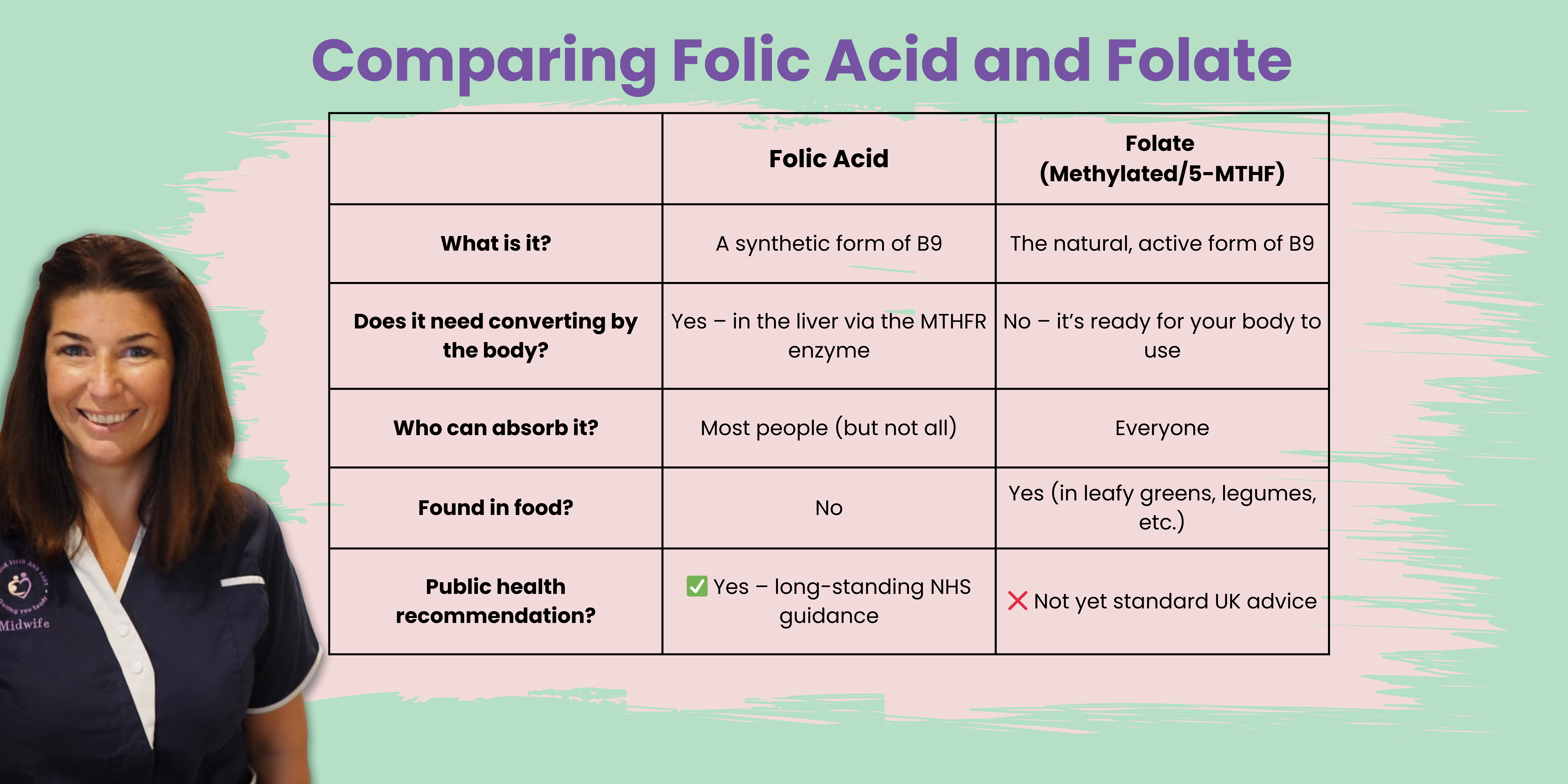
🔄 So Why Is Folic Acid Still Recommended?
Because historically, it worked. Fortifying food with folic acid and recommending it to people trying to conceive has dramatically reduced neural tube defects (NTDs) like spina bifida in many populations.
It’s stable, cheap, and well-studied. But it isn’t perfect — and it isn’t active in the body until it’s converted by your liver. And that’s where things get interesting.
🧬 The MTHFR Gene – Why Folate Might Be Better
Some people (estimated 40–60% of the population) have a variant of the MTHFR gene that makes it harder for them to convert folic acid into the usable form of B9. For a smaller group, this reduced conversion is significant enough that they may not absorb enough folic acid, even if they’re taking the recommended amount.
This doesn’t mean folic acid is dangerous — but it does mean methylfolate might be the safer, more inclusive optionfor everyone.
💡 Methylfolate (5-MTHF) skips the conversion step altogether and is immediately usable by the body — no genetic loopholes required.
🌿 Why Folate (Methylfolate) Is Gaining Ground
Here’s why more midwives, nutritionists, and functional medicine specialists are starting to recommend methylfolateover folic acid:
- It’s bioavailable (meaning your body can absorb and use it instantly)
- It works regardless of your genetic makeup
- There’s no build-up of unmetabolised folic acid, which some early research suggests might be linked to long-term effects (still under investigation)
It’s not that folic acid is wrong — it’s just that folate may be more universally effective.
💊 So What’s the Right Dose?
If you’re switching to methylated folate (5-MTHF), you still want to aim for the equivalent of 400 micrograms (mcg)per day.
That means:
👉 Look for a supplement containing 400mcg of 5-MTHF (methylfolate) — NOT just folic acid
👉 Make sure it’s labelled clearly — avoid “folate equivalent” without stating the active form
👉 Some high-quality pregnancy multivitamins already include methylfolate instead of folic acid – just check the label
If you’re in a higher risk category (e.g. previous NTD, epilepsy medications, or diabetes), your GP may advise a higher dose, and that conversation should be tailored to you.
💬 So Should I Take Folate Instead?
If you’re asking me, the answer is: Yes – if you can, it makes sense.
You’re not doing anything wrong by taking folic acid — it’s safe, it’s widely used, and for many people, it’s effective. But folate, particularly 5-MTHF, is:
- Already active
- Safe at the recommended dose
- Better absorbed by everyone
- Free from the need for genetic testing to see if it’s working
So if you want to ditch the synthetic stuff and go with the form that supports everybody’s biology, methylfolate is a brilliant choice.
For a good quality brand try Purolabs (please note this is not an affiliate link)
🗣 Final Thoughts from The Honest Midwife
This isn’t about panic. It’s about progress.
Folic acid has saved lives — no question. But folate might just be the better version of a good thing.
If you’re choosing a prenatal supplement now and you’re able to access one with methylated folate (5-MTHF), I’d say go for it.
For more information on what you should be taking in early pregnancy why not take a look at my FREE Early Pregnancy Workshop